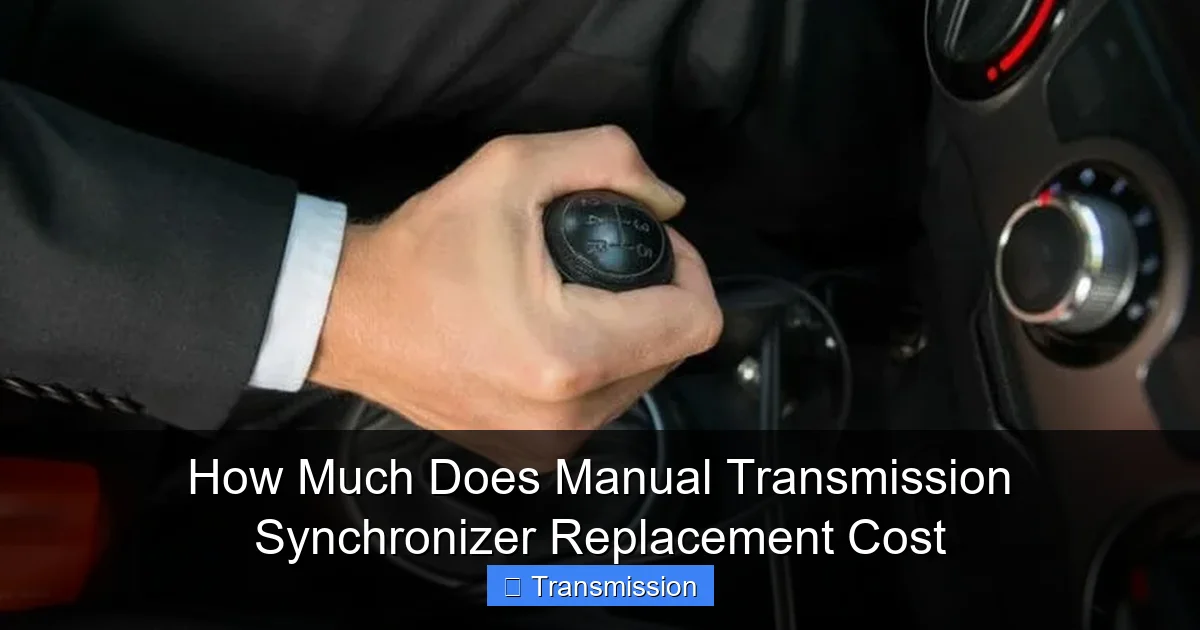
How Much Does Manual Transmission Synchronizer Replacement Cost
Expect manual transmission synchronizer replacement to be a substantial repair, typically costing anywhere from $800 to well over $2,500. This significant investment is driven by extensive labor—often 8-15 hours—required to remove, disassemble, and reassemble the transmission, alongside the cost of new synchronizer parts and other necessary components.
How Much Does Manual Transmission Synchronizer Replacement Cost
Hey there, fellow stick-shift enthusiast! If you’re reading this, chances are you’ve experienced that gut-wrenching, tooth-grinding sound when shifting gears, or maybe your trusty manual transmission just isn’t feeling as crisp as it used to. It’s a common, albeit annoying, problem that often points to one culprit: worn-out synchronizers. And let’s be honest, when your car starts acting up, the first thing that pops into your head (after a sigh of frustration) is, “How much is this going to set me back?”
I totally get it. Dealing with car repairs can feel like navigating a minefield, especially when it comes to something as complex as a transmission. You love the control, the engagement, the pure driving joy a manual transmission offers, but when it starts to falter, that love can quickly turn to worry. The good news is, you’re not alone, and understanding the potential manual transmission synchronizer replacement cost is the first step toward getting your beloved car back in top shifting form.
In this post, we’re going to dive deep into everything you need to know about manual transmission synchronizer replacement cost. We’ll talk about what these little heroes do, what signs to look for, the factors that influence the price tag, and what you can expect when you get a repair quote. My goal is to equip you with the knowledge to walk into a mechanic’s shop with confidence, ready to make an informed decision for your car and your wallet.
Key Takeaways
- Expect Wide Costs: Synchronizer replacement varies significantly, $500 to over $2,500.
- Labor Drives Cost: Professional labor is the largest expense; DIY saves substantially.
- Get Multiple Quotes: Compare shops; independent mechanics often offer better value.
- Diagnosis is Key: Confirm synchronizers are the issue to avoid misdiagnosis costs.
- Parts Cost Varies: OEM parts are expensive; aftermarket or used options exist.
- Consider Full Rebuild: Sometimes, a complete transmission rebuild is more cost-effective.
- Preventative Care Helps: Regular fluid changes can extend synchronizer lifespan.
Quick Answers to Common Questions
What’s the typical range for manual transmission synchronizer replacement cost?
Generally, you can expect the manual transmission synchronizer replacement cost to range from $1,000 to $3,000 or more, depending on your vehicle and the shop. This estimate covers both parts and significant labor.
Why is manual transmission synchronizer replacement so expensive?
The high manual transmission synchronizer replacement cost primarily stems from the intense labor involved; the transmission often needs to be removed and disassembled to access the synchronizers. While the parts themselves aren’t always pricey, the intricate work drives up the bill significantly.
Does the type of car I drive impact the manual transmission synchronizer replacement cost?
Absolutely! The manual transmission synchronizer replacement cost can vary greatly based on your vehicle’s make and model. Luxury cars or those with harder-to-find parts will typically have higher costs.
Can I save money by attempting a DIY manual transmission synchronizer replacement?
Unless you’re an experienced mechanic with specialized tools and knowledge, attempting a DIY manual transmission synchronizer replacement isn’t recommended. This complex job requires precision, and mistakes can lead to even more costly damage.
What typically contributes most to the overall manual transmission synchronizer replacement cost – parts or labor?
For manual transmission synchronizer replacement cost, labor almost always makes up the lion’s share. It’s an intensive job requiring many hours to remove, disassemble, repair, and reassemble the transmission.
📑 Table of Contents
- What Exactly Are Manual Transmission Synchronizers, Anyway?
- Signs Your Synchronizers Might Be Saying Goodbye
- Diving into the Manual Transmission Synchronizer Replacement Cost Factors
- The Typical Manual Transmission Synchronizer Replacement Cost Breakdown
- Can You Prevent Synchronizer Wear and Tear?
- Deciding Between Repair, Rebuild, or Replacement
- Conclusion
What Exactly Are Manual Transmission Synchronizers, Anyway?
Before we talk about manual transmission synchronizer replacement cost, let’s understand what these components are. Imagine trying to catch a ball that’s spinning really fast with another ball that’s not spinning at all. It would be a pretty jerky, messy catch, right? That’s kind of what shifting gears would be like without synchronizers. These unsung heroes in your manual transmission are tiny but mighty components that play a crucial role in making your gear changes smooth and effortless.
The Unsung Heroes of Smooth Shifts
Every time you press the clutch pedal and move the shifter, you’re essentially asking different gears inside your transmission to mesh together. But here’s the kicker: these gears might be spinning at different speeds. If they just slammed into each other, you’d hear a horrible grind, and eventually, the gears themselves would get damaged. This is where synchronizers step in. Their job is to literally “synchronize” the rotational speeds of the gear you’re shifting into with the main shaft, allowing for a seamless engagement.
How They Prevent Gear Grinding
Think of a synchronizer as a friction clutch within the transmission itself. As you move the shifter towards a new gear, the synchronizer ring (a key part of the synchronizer assembly) makes contact with a cone on the gear. This friction quickly matches the speeds of the two components. Once their speeds are aligned, a sleeve then slides over both the synchronizer ring and the gear, locking them together. It all happens in a fraction of a second, and it’s this ingenious design that prevents that dreaded grinding noise and makes shifting feel so natural. So, when these components start to wear out, that smooth operation disappears, and the need to consider manual transmission synchronizer replacement cost becomes very real.
Signs Your Synchronizers Might Be Saying Goodbye
Knowing what your car is trying to tell you can save you a lot of headaches and potentially more expensive repairs down the line. When your synchronizers start to fail, your manual transmission will usually give you some pretty clear warnings. Don’t ignore them! Addressing these issues promptly can sometimes affect the overall manual transmission synchronizer replacement cost, preventing further damage.
Visual guide about manual transmission synchronizer replacement cost
Image source: vehiclefreak.com
Grinding Noises and Difficult Shifts
This is probably the most common and unmistakable sign. If you hear a distinct grinding sound when shifting into a particular gear (or multiple gears), especially if you’re engaging the clutch fully, your synchronizer for that gear is likely worn. It’s the sound of metal parts trying to force their way together without their speeds being matched properly. Similarly, if you find yourself having to really force the shifter into a gear, or if it feels “sticky” and resistant, that’s another strong indicator.
Gears Popping Out of Place
Imagine driving along, and suddenly, your car just pops out of gear – often accompanied by a lurch. This can be startling and definitely dangerous. While this could be caused by other issues, worn synchronizers, particularly if their locking mechanism is compromised, can contribute to gears not staying properly engaged. They just can’t hold the gear in place like they used to, leading to these unexpected disengagements.
The “Sticky” Shifter Feeling
Beyond grinding, you might notice a general lack of fluidity in your gear changes. The shifter might feel reluctant to move into position, almost as if it’s catching on something. This “sticky” or “notchy” sensation often means the synchronizer isn’t doing its job efficiently, making it harder for the gears to engage smoothly. Paying attention to these early warnings can help you anticipate the manual transmission synchronizer replacement cost before the problem escalates.
Diving into the Manual Transmission Synchronizer Replacement Cost Factors
Alright, let’s get down to the nitty-gritty: what actually drives the manual transmission synchronizer replacement cost? It’s not a one-size-fits-all answer, as several factors come into play. Understanding these can help you better interpret quotes and budget for the repair.
Labor Costs: The Biggest Chunk
For most transmission repairs, including synchronizer replacement, labor is usually the largest portion of the bill. Why? Because accessing the synchronizers isn’t a simple task. The transmission often needs to be removed from the vehicle entirely, then meticulously disassembled, the faulty synchronizer(s) replaced, and everything carefully reassembled and reinstalled. This is a highly skilled job that requires specialized tools and a lot of time. Depending on the vehicle and the mechanic’s hourly rate, labor alone can easily account for hundreds, if not over a thousand, dollars.
Parts Costs: Varies by Vehicle and Specific Synchronizer
The cost of the synchronizer parts themselves can vary widely. Some transmissions might use a single synchronizer ring per gear, while others have more complex assemblies. Factors include:
- Vehicle Make and Model: Parts for a common compact car will generally be less expensive and easier to find than those for a luxury sports car or an older, rare model.
- OEM vs. Aftermarket: Original Equipment Manufacturer (OEM) parts, bought directly from the car maker, are typically more expensive but guarantee a perfect fit and quality. Aftermarket parts can be cheaper but quality varies.
- Individual Synchronizer vs. Kit: Sometimes, only one synchronizer needs replacing. Other times, shops might recommend replacing all synchronizers for a particular gear set or even an entire transmission synchronizer kit, especially if the transmission is already apart. This can push the manual transmission synchronizer replacement cost higher.
Vehicle Make, Model, and Year
As mentioned, your specific car plays a huge role. A Honda Civic’s manual transmission synchronizer replacement cost will likely be significantly less than, say, a Porsche 911’s. This is due to differences in transmission design complexity, the cost and availability of parts, and the specialized knowledge or tools required to work on certain high-end or older vehicles. Older cars might also have harder-to-find parts, potentially leading to longer wait times and higher prices.
Shop Location and Type
Where you get the work done also influences the price. Labor rates vary geographically, with shops in major metropolitan areas often charging more than those in rural towns. Furthermore:
- Dealerships: Typically the most expensive option, but they use OEM parts and have factory-trained technicians.
- Independent Mechanics: Often a good balance of expertise and affordability. Many specialize in transmission work.
- Transmission Specialists: These shops focus solely on transmissions and often have the deepest expertise, which can sometimes lead to more efficient (and thus, potentially cheaper labor hours) repairs, but their hourly rates might be competitive.
Always get a few quotes! Don’t hesitate to call around and explain your situation to different shops to compare their manual transmission synchronizer replacement cost estimates.
The Typical Manual Transmission Synchronizer Replacement Cost Breakdown
Now, let’s talk numbers. While it’s impossible to give an exact figure without knowing your specific situation, we can definitely provide some general ranges and a typical breakdown of the manual transmission synchronizer replacement cost. Remember, these are estimates, and your actual cost could be higher or lower.
When you get a quote for manual transmission synchronizer replacement cost, it generally covers a few key areas:
- Labor: This is almost always the biggest chunk. We’re talking anywhere from 8 to 20+ hours of labor, depending on how complex your transmission is to remove, disassemble, repair, and reinstall. At an average shop rate of $100-$150 per hour, you’re looking at $800 to $3,000+ for labor alone.
- Parts (Synchronizers): As discussed, these vary. A single synchronizer ring might cost $50-$200. If you’re replacing multiple, or a whole kit for one gear, it could be $200-$600 or more.
- Related Parts & Fluids: When the transmission is out, it’s a good idea to replace other wear items. This might include:
- Input/Output Shaft Seals: Often replaced when the transmission is removed ($20-$50 each).
- Transmission Fluid: You’ll need fresh fluid ($50-$150, depending on type and capacity).
- Clutch Slave Cylinder/Throwout Bearing: Sometimes, if your car’s clutch components are aging and easily accessible during this job, a mechanic might suggest replacing them to save on future labor ($100-$300+ for parts). This isn’t strictly part of the manual transmission synchronizer replacement cost but is often a smart “while you’re in there” job.
- Gaskets and O-rings: Small but essential for reassembly ($20-$100).
Let’s look at some typical scenarios to give you a rough idea:
| Vehicle Type / Scenario | Estimated Labor Cost | Estimated Parts Cost | Total Estimated Manual Transmission Synchronizer Replacement Cost |
|---|---|---|---|
| Basic Compact Car (e.g., Honda Civic, Ford Focus) – Replacing 1-2 synchronizers | $800 – $1,500 | $150 – $400 | $950 – $1,900 |
| Mid-Range Sedan/SUV (e.g., Toyota Camry, Subaru Outback) – Replacing multiple synchronizers, basic related parts | $1,200 – $2,200 | $300 – $700 | $1,500 – $2,900 |
| Performance Car / Truck (e.g., Mustang GT, F-150) – Extensive synchronizer work, higher parts cost, complex removal | $1,800 – $3,000+ | $500 – $1,000+ | $2,300 – $4,000+ |
As you can see, the manual transmission synchronizer replacement cost can range quite a bit. Always get a detailed quote from a trusted mechanic that clearly outlines labor hours, parts costs, and any additional components they recommend replacing.
Can You Prevent Synchronizer Wear and Tear?
While synchronizers are wear items and will eventually need attention, there’s definitely a lot you can do to extend their life and potentially push back that manual transmission synchronizer replacement cost for as long as possible. A little care goes a long way!
Proper Shifting Techniques
This is probably the single most important factor. Here are some tips:
- Fully Depress the Clutch: Make sure the clutch pedal is pushed all the way to the floor before you attempt to shift. This fully disengages the transmission from the engine, allowing the synchronizers to do their job without fighting engine torque.
- Don’t Force Shifts: If a gear isn’t engaging smoothly, don’t muscle it in. Release the clutch, try again, or shift to a different gear (like neutral, then slowly back to the desired gear) to help align the speeds. Forcing it just grinds the synchronizer more, accelerating wear.
- Smooth and Deliberate Shifts: While quick shifts can be fun, slamming the shifter through the gates puts more stress on the synchronizers. Aim for smooth, deliberate movements that allow the synchronizers time to do their job.
Regular Transmission Fluid Changes
Just like engine oil, transmission fluid is vital. It lubricates the internal components, helps cool the transmission, and provides the hydraulic pressure for proper operation (in automatics, but still key for manual lubrication). Over time, this fluid breaks down, loses its lubricating properties, and can become contaminated with tiny metal particles. Old, dirty fluid can directly contribute to increased wear on your synchronizers.
- Follow Manufacturer Recommendations: Check your car’s owner’s manual for the recommended transmission fluid type and change intervals.
- Use the Correct Fluid: This is critical. Using the wrong type of transmission fluid can cause more harm than good, as different fluids have different friction modifiers and viscosities designed for specific transmissions.
Avoiding “Power Shifting” and Aggressive Driving
While thrilling for some, “power shifting” (shifting without lifting off the accelerator) or constantly driving very aggressively puts immense strain on your entire drivetrain, especially the transmission’s internal components, including the synchronizers. The increased torque and speed differentials place excessive stress on these parts, dramatically shortening their lifespan. Gentle, mindful driving extends the life of your transmission components and helps delay that inevitable manual transmission synchronizer replacement cost.
Deciding Between Repair, Rebuild, or Replacement
When you’re facing a significant manual transmission synchronizer replacement cost, it naturally leads to a bigger question: is it worth just fixing the synchronizers, getting the whole transmission rebuilt, or even replacing the entire transmission with a new or remanufactured one? For some, it might even spark the thought of a new car altogether. It’s a tough decision, and here’s how to think through it:
Just Synchronizer Replacement
This is the most targeted approach. If your mechanic definitively diagnoses worn synchronizers and finds no other significant damage within the transmission (like worn bearings, chipped gears, or a damaged main shaft), then replacing only the affected synchronizers makes the most sense. This is often the most cost-effective option for addressing the specific problem, and it will generally be at the lower end of the manual transmission synchronizer replacement cost spectrum. It’s ideal if your transmission is otherwise healthy.
Full Transmission Rebuild
A rebuild involves removing the transmission, disassembling it completely, inspecting every component, and replacing all worn or damaged parts – not just the synchronizers. This would include bearings, seals, gaskets, and potentially other gears. A rebuild is often recommended if your transmission has higher mileage, shows signs of general wear beyond just the synchronizers, or if the manual transmission synchronizer replacement cost alone is already a significant portion of a rebuild cost. While more expensive upfront (often $2,000 – $4,500+), a rebuild essentially gives you a “like-new” transmission, potentially extending the life of your vehicle considerably.
Used or Remanufactured Transmission
Sometimes, getting a completely different transmission might be an option:
- Used Transmission: This is typically the cheapest option for a full transmission unit ($500 – $2,000 for the part, plus labor for installation). However, it comes with a gamble. You don’t know the history of the used transmission, and it could have its own set of problems. Warranties are usually very limited.
- Remanufactured Transmission: This is a more reliable option. A remanufactured transmission has been professionally rebuilt by a specialized facility, often to higher-than-OEM standards, with all wear items replaced. They usually come with a decent warranty (e.g., 1-3 years). The cost is typically higher than a used unit but less than a full rebuild by your local shop (often $1,500 – $3,500 for the part, plus labor).
In both cases, you’d still have to factor in the labor to remove your old transmission and install the replacement, which adds to the overall manual transmission synchronizer replacement cost decision.
When to Consider a New Vehicle
This is the toughest call. If the manual transmission synchronizer replacement cost, or the cost of a full rebuild or replacement transmission, approaches or exceeds the current market value of your vehicle, it might be time to seriously consider moving on. For example, if your car is only worth $3,000, and a repair quote comes in at $2,500 for a rebuild, investing that much might not be financially wise, especially if other major components (like the engine or suspension) are also showing their age. It’s a purely economic decision that weighs repair costs against the value and remaining lifespan of your car.
Always weigh the pros and cons, get multiple opinions, and consider the overall health and sentimental value of your car before making a final decision.
Conclusion
So, there you have it – a deep dive into the often-dreaded, but ultimately manageable, world of manual transmission synchronizer replacement cost. It’s certainly not the cheapest repair you’ll encounter, but understanding what causes the problem, the signs to look for, and the factors that influence the price can empower you to make the best decision for your car and your wallet.
Remember, those grinding noises and tough shifts are your car’s way of telling you it needs a little TLC. By being proactive, practicing good shifting habits, and keeping up with transmission fluid maintenance, you can significantly extend the life of your synchronizers. And when the time does come for repair, armed with this knowledge, you’ll be well-prepared to get a fair quote and feel confident in the choices you make.
Don’t let a faulty synchronizer dampen your love for driving a stick shift. With the right information and a trusted mechanic, you’ll be back to enjoying those smooth, satisfying gear changes in no time. Happy driving!
Frequently Asked Questions
What is a manual transmission synchronizer and why might it need replacement?
A manual transmission synchronizer is a component that helps match the rotational speed of the gear you’re selecting with the input shaft, allowing for smooth, grind-free gear changes. Over time, constant use can wear down the friction surfaces or “cones” of the synchronizer, leading to difficult shifting or grinding noises. Replacing a worn synchronizer restores smooth gear engagement and prevents further damage to the transmission.
What is the average cost to replace a manual transmission synchronizer?
The average cost for manual transmission synchronizer replacement typically ranges from $800 to $2,500, but this can vary significantly. This estimate generally includes both the cost of parts and the extensive labor required to open and reassemble the transmission. Individual synchronizers themselves are usually inexpensive, but the labor is substantial.
What factors influence the total cost of synchronizer replacement?
Several factors affect the total cost, including the make and model of your vehicle, the specific synchronizer needing replacement (e.g., 1st, 2nd, 3rd gear), and whether other transmission components are replaced simultaneously. Labor rates also vary by region and the chosen repair shop. More complex transmissions or those in tight spaces can increase labor hours.
Can I replace just one synchronizer, or do I need to replace them all?
Generally, you can replace individual manual transmission synchronizers if only one or a few are showing signs of wear. However, since the transmission must be removed and disassembled for any synchronizer replacement, many mechanics recommend inspecting and potentially replacing other worn synchronizers or related components as a preventative measure to save on future labor costs. This “while you’re in there” approach can be cost-effective in the long run.
What are the signs of a failing manual transmission synchronizer?
The most common signs of a failing synchronizer include grinding noises when shifting into a particular gear, difficulty engaging a gear (especially when downshifting), or the transmission popping out of gear. You might also notice a “crunch” feel through the shift lever. These symptoms indicate that the synchronizer is no longer effectively matching gear speeds.
Is replacing a manual transmission synchronizer a DIY job, or should I hire a professional?
Replacing a manual transmission synchronizer is a complex and labor-intensive job that is generally not recommended for DIY mechanics unless they have advanced automotive experience, specialized tools, and a proper workspace. It requires removing the transmission from the vehicle, disassembling it, replacing internal components, and carefully reassembling everything. Professional expertise ensures proper installation and avoids potential damage to other transmission parts.